SGT Robert A. Dickman

Source: WW2-Airborne.us
Sergeant (SGT) Robert A. Dickman of Able Battery, 907th Glider Field Artillery Battalion (GFAB), was born in Riley Township, Sandusky County, Ohio, to Francis J. and Josephine L. (Durnwald) Dickman on February 11, 1918. Robert had five brothers, Paul J., Bernard C., Raymond W., Leo M., and Frank G. Dickman Jr., and five sisters, Loretta C., Anna R., Mary M., Josephine M., and Evelyn G. Dickman.
His brother Leo served with the Military Police during WWII.
Robert attended Clyde High School and was working for the Davidson Enamel Company at Clyde when he went into the service. Davidson Enamel Company was a local Clyde factory that produced parts for appliances and refrigerators, including those made by Kelvinator and Crosley.
Robert enlisted at Camp Perry, Lacarne, Ottawa County, Ohio, on March 25, 1942. He was assigned to Able Battery of the 907th GFAB, located at Camp Claiborne, Louisiana, at that time.
His training included time at Camp Claiborne and Fort Bragg, Georgia, after which he moved with the battalion to the staging area at Camp Shanks, New York, on August 22, 1943. On 4 September, the 907th set sail for England on the SS Strathnaver. Due to several problems with the Strathnaver, all the units aboard the ship were transferred to the SS Ericson in Newfoundland to resume the journey across the Atlantic Ocean, arriving at Liverpool, England, on 18 October.
On June 7, 1944, the 907th GFAB was aboard the Susan B. Anthony, together with soldiers of the 90th Infantry Division, the 326th Airborne Engineer Battalion, as well as a group of men from the 321st GFAB. Early in the morning, the ship went en route to Utah Beach, but hit a mine before it reached the Normandy coast. Initially, an attempt was made to tow the ship to shallow waters, but when a fire erupted, and the Susan B. Anthony began to settle more rapidly, the captain concluded that the ship was lost and ordered her abandoned. All aboard, 2,689 people, consisting of the troops it carried as well as the ship’s crew, were saved, which the Guinness Book of World Records lists as the largest rescue of people without loss of life.
After taking part in the battalion’s combat period in Normandy, SGT Dickman boarded the LST 316 (Landing Ship Tank) on July 11 with Able Battery, and left in convoy from a Normandy Beach for Southampton, England. After his return to the battalion’s base camp at Newbury, England, and doing maintenance and turning in some equipment the next two days, he was granted a 7-day furlough on 15 July.
On September 17, 1944, Operation Market Garden was launched. On the first two days, the artillery units had lower priority in planning flights from England to the Netherlands, but because they were much needed, the 101st Airborne Division was assigned 385 gliders to bring in the artillery and anti-tank units on D+2.
The flying weather had been good for the first two days, but it worsened on September 19 with heavy fog over the Channel and coastal areas. As a result, most of the planes and gliders turned back to England.
Robert Minick’s book, “Kilogram: The Story of the 907th Glider Field Artillery Battalion,” describes what PVT Harold Fransen witnessed after his glider had returned safely at Membury Airfield.
“A few minutes after PVT Fransen exited from his glider, he looked up to his right, just in time to witness a most tragic scene. Two of the ‘A’ Battery gliders suddenly turned toward one another and rammed head-on. For a split second, the two entangled gliders seemed to hang in mid-air, and then broke apart. A jeep, its driver still sitting rigid at the steering wheel and his buddy slumped beside him, tore out through the front of one of the gliders and plummeted to the ground. The two gliders then crashed, one of them bursting into a brilliant white flame from the phosphorus shells on board. Six artillerymen and the pilots lost their lives in the mishap.”
One of those casualties was SGT Robert Dickman. Another Screaming Eagle had soared to the ultimate height. 🦅
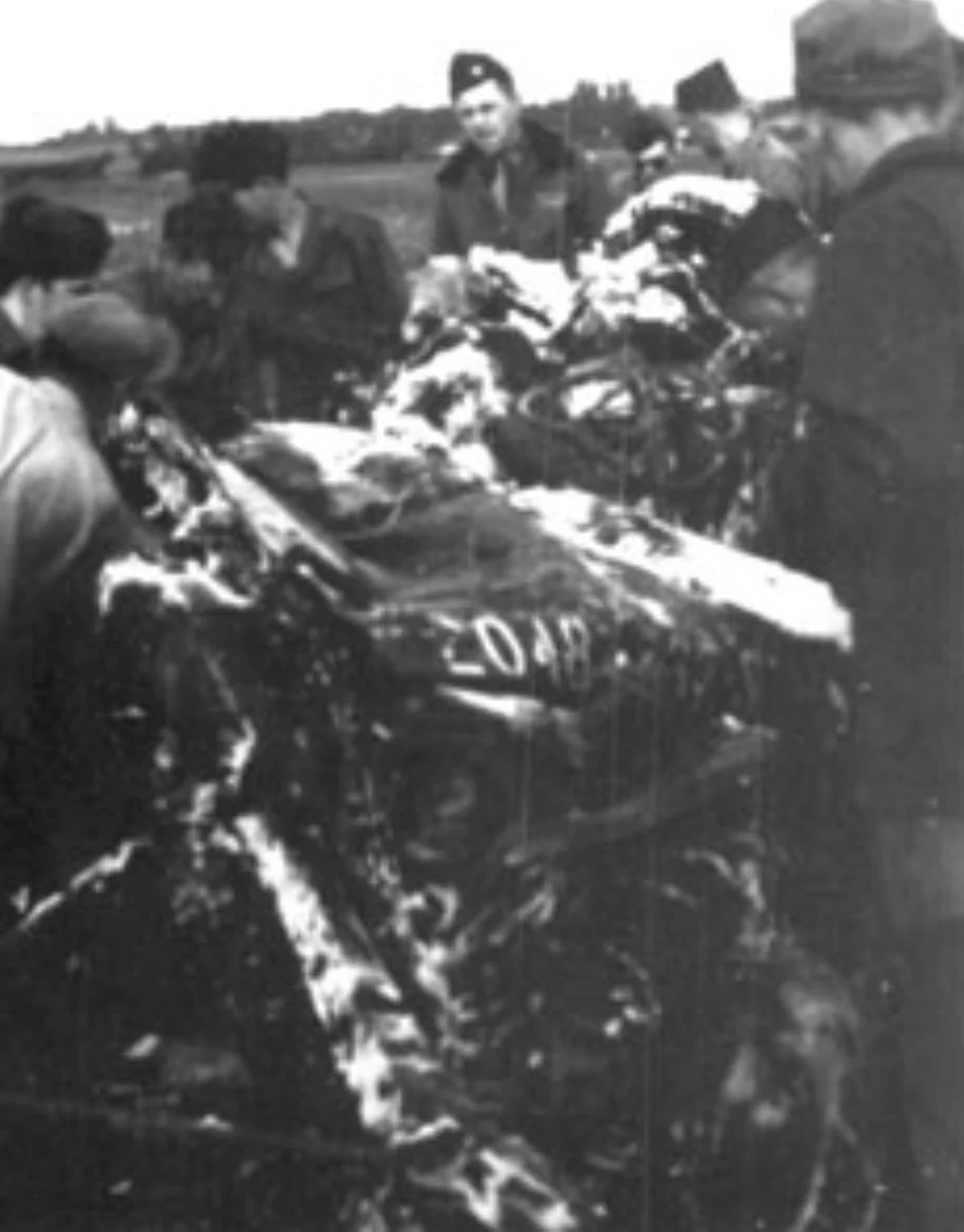
The remains of one of the gliders, including the hood of a jeep, visible in the foreground. Source: ramsburyatwar.com
SGT Robert Dickman died at the age of 26 in England. He was posthumously awarded a Purple Heart Medal. On September 21, 1944, he was first buried at the Temporary American Military Cemetery of Cambridge, Cambridgeshire, England, which lies between the villages of Coton and Madingley, north-west of Cambridge. He was later reburied at Saint Mary’s Cemetery, Clyde, Sandusky County, Ohio.
May he rest in peace.
Happy Birthday in Heaven, Robert.
Lest we forget. 🇺🇸
Sources:
Family Search
NARA
Hell’s Highway by George Koskimaki
Kilogram: The Story of the 907th Glider Field Artillery Battalion by Robert Minick